The release program
15 tests on every new batch. 23 units tested.
Every new batch takes 15 tests, on 23 units, at outside labs. If it fails one, we do not sell it. Every report is published the way the lab sent it.
Earlier batches were tested to our earlier standard, 7 to 14 tests. Every certificate shows exactly which tests that batch had.
Create your free researcher accountSee a real lab reportFree · takes about a minute · 21+, research use only
A new batch waits in a locked room
Nothing leaves until the report says it passed.
A closer look
In Testing means the batch is received and awaiting its certificate. It is released within a week of the report clearing. Release is a human click by our quality team, never automatic.
Three questions
Is it the right thing? Is it clean? Will it stay good?
- Is it what the label says?Purity and strength, measured on each batch.
- Is it clean?Germs checked two ways at two labs, plus germ dust, metals and leftover liquids.
- Will it hold up?Sealed vials, confirmed to dissolve, the cutting acid measured.
The 15 tests, one at a time
Tap one. The science sits one more tap in.
01Is it the right peptide?
Clean is not the same as right. This check makes sure it is the peptide on the label.
"Like matching a fingerprint. The lab runs a known sample of the real peptide beside ours. Both have to leave the same mark in the same place."
A closer look
Identity by HPLC-UV/VIS against a reference standard (USP <621>). Run on the finished vial at the outside lab, every batch. A typical seller shows a purity number with no identity row.
02Is it clean?
Not-quite-right copies look like the real thing but can change your answer. This number says how much is the real thing.
"Imagine a jar of a hundred beads. The lab counts how many are the right colour. We want 99 of 100 or better, in three jars from every batch. The lowest count decides."
A closer look
Chromatographic purity by HPLC (USP <621>). Three vials, the worst one governs; a printed ">99%" is reported as printed. Our rule is 99%; the lab's own pass mark is about 97%.
03How much is inside?
Clean does not tell you how much. This number is what you actually get.
"The label says 10 mg. The lab measures what is really inside and we print that real number, like 10.54 mg, on the size you pick. No scale involved."
A closer look
Assay by HPLC against a reference standard, printed unrounded as the tested mass; each peptide in a blend measured on its own. Often skipped in this category.
04Does the amount match the report?
The report should match the vial. This check says how close.
"The amount inside should be close to the amount the report says. Not too much, not too little."
A closer look
Content vs certificate: the measured amount against the amount the certificate states, USP 90–110% of label as the convention. Computed by us on every certificate.
05Do the vials match each other?
The report should be true for your vial, not just for the batch on average.
"Three vials from the same batch should hold about the same amount. If one is much fuller or emptier, the batch does not pass."
A closer look
Between-unit variation, a house check on three units with USP <905> as the reference; 10% for vials, 15% for capsules.
06Is anything in there that should not be?
"Nothing extra in here" should be checked, not promised.
"Besides "is the right thing in here", the lab asks "is anything else in here". The answer we want: none found."
A closer look
Adulterant screen by HPLC on every full-panel batch. The analyte is not printed.
07Any metal?
Metal can sneak in from the tools and chemicals. Only a machine this sensitive can find such tiny amounts.
"Tiny traces of metal can sneak in from the chemicals and tools used to make a peptide. A very sensitive machine counts them in parts per billion."
A closer look
Arsenic, cadmium, lead, mercury, chromium by ICP-MS; USP <232> limits, <233> method. Limits printed; the record across all batches shown live.
08Any germ dust?
No live germs is not the same as no germ dust. This test finds the dust.
"Even when germs are gone, they can leave bits of themselves behind. The LAL test reacts to those bits."
A closer look
Bacterial endotoxin by LAL (USP <85>), two vials, limit as printed on the certificate. Rarely tested in this category.
09Any leftover cleaning liquid?
The liquids are tools, not part of the peptide. The only good answer is none left.
"Making a peptide uses strong liquids to build it and wash it. When it is finished, none should be left. A gas machine sniffs for sixteen of them."
A closer look
Sixteen residual solvents by GC-MS (USP <467>), all not detected. Almost never tested in this category.
10Any leftover cutting acid?
It sticks to the peptide unless it is swapped out. This row proves the swap happened.
"The cutting acid is used to cut the peptide off the bead it was built on. It is a tool, not an ingredient, so we check none is left."
A closer look
Trifluoroacetic acid by ion chromatography (USP <503.1>), our rule: not detected under 0.10%. We sell the acetate. "A test most vendors skip."
11Is the vial sealed tight?
Clean only stays clean if the seal holds all the way to you. The vacuum can vary; the seal is what is tested.
"The vial is dunked in coloured dye under pressure. If any colour gets inside, the seal is not tight."
A closer look
Container closure integrity by dye ingress (USP <1207> as reference), two vials. Not tested in this category.
12Does it dissolve?
If it will not dissolve, you cannot use it, and it can be the first sign something went wrong.
"Add water. It should turn clear with nothing floating and nothing stuck to the glass."
A closer look
Solubility, two vials, checked by eye (USP <1236> as reference; USP <1> for a clear solution). Not tested in this category.
13Any germs? The two-week test
Germs in a vial are the worst thing that can go wrong. This is the test everyone in the industry trusts.
"A drop from each of five vials goes into a broth germs love. The lab waits two weeks. If anything grows, the vial fails."
A closer look
USP <71> at Vanguard: five vials on the full panel, 14-day incubation. We have seen two or three of the vials fail while the rest passed; every one of those batches was destroyed.
14Any germs? The fast test
Some germs are slow and hide from the first test. This one looks a different way. A batch has to pass both.
"A machine paints living germs with a glowing dye and counts them one by one. No waiting. Four more vials, a second lab."
A closer look
ScanRDI at Eagle Analytical, four vials, an alternative to the USP <71> growth test run in addition to it. Two labs, two methods, nine vials.
15Did the lab check its own work?
Someone should check that the whole report makes sense, not just each line.
"Before the report is signed, a second person at the lab reads the whole thing and checks it hangs together. Then our two scientists read it again."
A closer look
Conformity: the lab's QA approval row, shown on our pages, plus our own review before release.
How many units
We test 23 units from every batch, not one, because one good vial does not prove the rest are good.
A closer look
Per-test counts print from the submission sheet for that batch, never typed. Nine is a house sampling plan: USP <71>'s own batch-size table asks for more containers, so the page never says the table is met and never says USP mandates the five.
Two panels. Every row named.
The full panel is all 15 tests. Older batches carry 7 to 14. The seal says how many; the report says which.
- On both: is it the right peptide · is it clean · how much is inside · does the amount match the report · any metal · any germ dust · germs, two-week test · the lab's sign-off.
- Also on many earlier batches: germs, fast test at a second lab · do the vials match each other, where three vials were measured.
- Only on the full panel: anything that should not be there · leftover cleaning liquid · leftover cutting acid · is the vial sealed tight · does it dissolve · 23 units instead of a few.
A closer look
Counted the way the product page counts: the lab rows, the identity line and the computed content check. Basic-panel batches print 9 rows on most (8 with one germ test, 10 where three vials were measured); older full-panel batches print 12 to 14, most missing only the adulterant screen. Solutions and older capsule lots carry a shorter panel. The seal always shows the rows you can count on the report behind it, never a typed number.
How our testing got here
Five steps in eighteen months. Each one added a test, a lab, or a vial. The report for your batch shows which steps it had.
- February 2025: a lab report on every batch. One outside lab. Seven rows: is it the right peptide, is it clean, how much is inside, does that match the label, any germ dust, one germ test, the lab's sign-off.
- April 2025: heavy metals added. Eight rows.
- October 2025: germs checked two ways, at two labs. A batch has to pass both. Nine rows.
- February 2026: the full panel. Four tests added, and three vials measured instead of one. Fourteen rows. Every new batch since June.
- August 2026: the adulterant screen. Fifteen rows on every new batch, on 23 units. New labs must pass our checks first; Ethos Analytics joined in September.
A closer look
Dates are the test dates on our certificates, and the numbers are the rows the product page prints for a batch tested at that step. First report with heavy metals: 2 Apr 2025, batch 1353. First Eagle Analytical report: 5 Sep 2025, batch 1363; both germ tests on one batch from October 2025. First full-panel certificate: 26 Feb 2026, batch 1670. First adulterant screen: 29 Jul 2026, batch 1731. First Ethos Analytics report: 10 Sep 2026, batch 1754. A step counts as "every new batch" from the month the last batch without it was tested.
Nine vials go looking for germs
One bad vial and the whole batch is destroyed.
- Germs do not spread evenly.We have seen batches where two or three of the nine vials had germs and the other six or seven looked fine.
- That is why one vial is not enough.Test just one vial from a batch like that and, most of the time, it looks clean. The batch gets sold.
- We destroy it instead.If even one of the nine fails, the batch is quarantined and destroyed. It never goes on sale.
From real reports: three batches that failed
The lab's own pages. Nothing changed except the boxes. None of the three was sold.
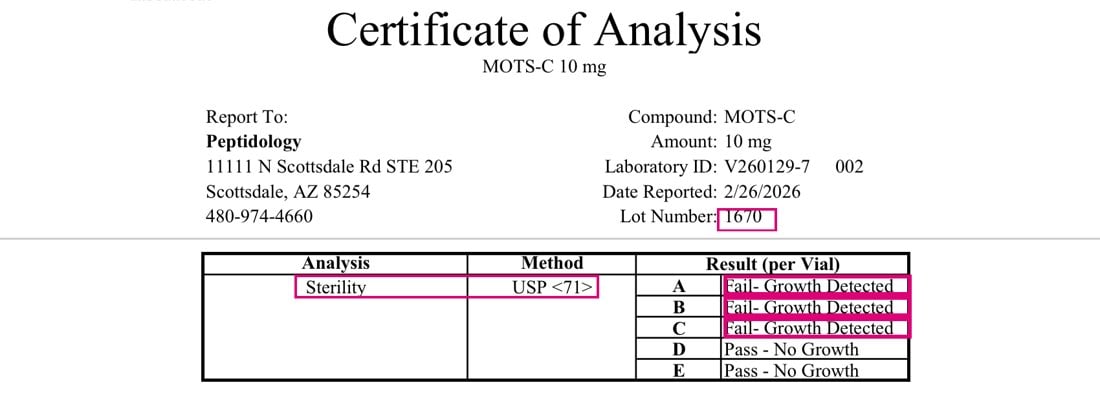
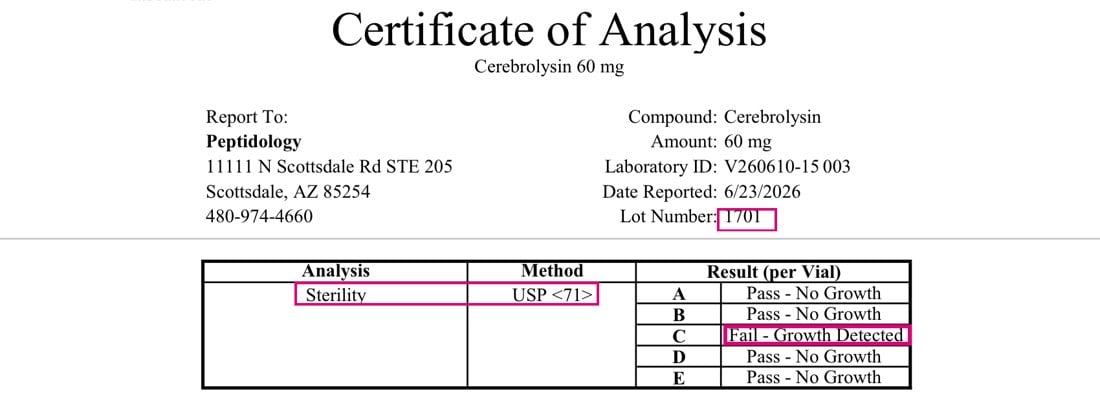
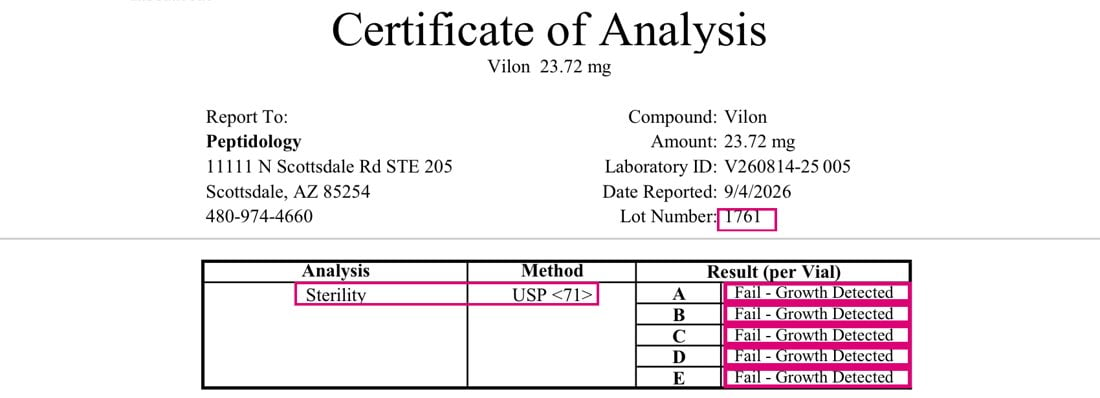
A closer look
Five units on the USP <71> growth test at Vanguard (14-day incubation) and four on ScanRDI at Eagle, from the same batch; both rows print and both must pass. A confirmed failure is never re-tested into a pass; a third test decides only when two labs disagree.
What pass means
Pass means the number stayed inside the line. The worst vial is the one that counts.
- PASS means the result met the limit for that test.
- "Not on this report" means the lab did not run that test on this batch.
- The number in brackets, like USP <71>, is the method the lab followed. It does not mean the product is a USP article.
A closer look
Purity: the worst measured vial governs; a printed threshold is reported exactly as printed. Between units: 10% vials, 15% capsules. Content vs certificate: 90–110% of the amount stated.
When a batch fails
A failed batch goes back into the locked room, gets tested again somewhere else, or is thrown away. We keep the record either way.
- Quarantined the same day.
- A case is opened.
- Tested again at a second lab, or withdrawn.
- The failed report stays in our records.
A closer look
When two labs disagree, the worse measured result governs and a third test settles germs, germ dust or metals. Rejecting a batch on any out-of-spec unit is stricter than the FDA out-of-specification guidance, which allows an investigation first.
Quality we do in our office
Two scientists who used to run labs and quality departments now run ours.
- A new batch goes into a locked room the day it arrives.
- Every single vial gets looked at by a person, for anything floating in it.
- We mix a couple of vials with water to make sure they dissolve clear, and keep two on the shelf to check later.
- We pick vials from all over the batch, not just the top of the box. If even one fails, the whole batch fails.
- We fill in the lab's form for each batch and send the vials overnight.
A closer look
Nichole and Torie, former QA managers and analytical lab directors, run the quality systems. Visible-particulate inspection of every unit (USP <790> and <1790> as references); clarity of the reconstituted solution (USP <1>); two units held back per batch, the reserve-sample practice of 21 CFR 211.170; samples pulled across the batch as 21 CFR 211.160 requires.
We follow the rules. Someone else checks our work.
The rulebook is not ours. The judges are not us. We write everything down.
- The rulebook is not ours. There is a big rulebook the pharmaceutical industry uses for testing. We use that one. We did not write it.
- The judges are not us. Outside labs do the checking. Other people check those labs, too.
- One thing is ours. We test more vials than the rulebook asks for. When a number is ours, we say "our rule" next to it.
What could go wrong if a rule got skipped
Is it the right peptide?
You could be testing the wrong thing and never know.
Is it clean?
Little bits of not-quite-right peptide sneak in and change your answer.
How much is inside?
You think you added 10, but you only added 8. Every number after that is off.
Do all the vials match?
Two vials from the same box give two different answers.
Is anything in there that should not be?
Something else does the work, and the peptide gets the credit.
Any metal?
Tiny bits of metal make cells sick. Sick cells give strange answers.
Any germ dust?
Bits of dead germs make immune cells shout. You would think your peptide did it.
Any leftover cleaning liquid?
Cleaning liquids left behind hurt cells.
Any leftover cutting acid?
It can hurt cells, and it takes up room in the vial, so there is less peptide than the label says.
Any germs?
Germs grow in your dish and ruin the experiment. We have seen two or three bad vials hiding among nine good-looking ones.
Is the vial sealed tight?
A tiny leak lets air and water in. The peptide slowly goes bad on the shelf.
Does it dissolve?
If some stays at the bottom, you do not know how much you really added.
Did a person look at every vial?
A speck of glass or fluff could go straight into your cells.
Is the lab checked too?
If nobody checks the checker, the report is just a promise.
Do we write it all down?
If something goes wrong, we can find which batch, which vial, and why.
Is it still good later?
The vial you open later should be the same as the one that was tested. We keep two back to check.
A closer look at the standards
USP general chapters for how each test is run and its limit; ISO/IEC 17025:2017 for the laboratories (A2LA, PJLA); the US cGMP regulations (21 CFR 211) followed as practice; ICH Q3C, Q3D and Q1A behind the solvent, metal and stability rules. Our rules, labelled as ours: purity 99%, TFA not detected under 0.10%, between-unit 10% and 15%, content 90–110%, nine vials for germs.
Most sellers do two or three tests. We do 15.
And we say which lab ran each one.
A closer look
Typical in this category is drawn from the June comparison and the September census; no competitor is named. Testing one batch costs about $3,000, before counting the batches that fail.
Testing one batch costs about $3,000.
That is before counting the batches that fail. We would rather pay than guess.
These numbers count themselves.
They come from the certificates, not from us.
Common questions
Short answers. Ask in chat for more.
How do I check this certificate is real?
- Every batch gets a report from an outside lab. We use Vanguard Laboratory (Washington), Eagle Analytical (Texas) and Ethos Analytics (Arizona). We do not test our own product.
- Some Vanguard reports are also on the lab's own website. Those show a "Verify online" link.
- Vanguard will check any of our reports for you: call (360) 967-7010 or email [email protected].
- To match a report to your vial: the batch number on the label should be the same as on the certificate.
How do I read this certificate?
- Each line is one test the lab ran on this batch, with the method the lab used.
- PASS means the result met the limit for that test. "Not on this report" means the lab did not run that test on this batch.
Which batch will I get, and does it match the certificate?
- The batch number is printed on your product label. When your order arrives, check it against the certificate.
- If the batch on your label does not match the certificate shown, tell us: free replacement.
Ready when you are
Register free. See every lab report. Order today, ships today.
Create your free researcher accountWho tests it →For research use only. Not intended for diagnostic or therapeutic use. Registration confirms you are at least 21 and purchasing solely for research purposes.
For research use only. Not intended for diagnostic or therapeutic use.